Not on their own. When the grid fails, a standard solar installation switches itself off within a second, even in full sun, because UK grid rules require it. Most batteries do the same. To keep power you need a battery fitted with an EPS output or a backup gateway.
That matters more than it used to. The government now asks every UK household to be able to look after itself for three days. Tinned food, bottled water, a torch, a wind-up radio. It is sensible advice and it is easy to act on.
There is one part of the list nobody explains properly: electricity. A torch gets you through an evening. It does not keep a freezer cold, a router online, a phone charged or a heating system running for 72 hours.
If you already have solar panels, or solar and a battery, you would be forgiven for assuming you are covered. Most people with solar are not, and the reason is worth understanding before you need it.
What the government’s power cut preparation advice actually says
The government’s Be Ready campaign asks households to be able to cope on their own for about three days, so emergency services can concentrate on hospitals, care homes and people without anyone to help them.
It lists the risks it has in mind: storms, flooding, water outages, cyber attacks on infrastructure, phone and broadband failures, and power cuts. The campaign’s own power cuts page is blunt about it — most outages are short and local, but longer ones lasting several days are possible, and in a national shortage supply could be rotated area by area using load block letters.
The kit list is the part that made the papers: bottled water, tinned food that needs no cooking, a manual tin opener, batteries, a torch, a battery or wind-up radio, a power bank, a first aid kit, cash, baby and pet supplies.
It is a good list. It is also a list that assumes you will simply go without power, rather than one that asks whether you could generate your own.
The uncomfortable bit: most solar systems switch off in a power cut
If the grid goes down on a bright afternoon, a standard solar installation stops generating. The panels are fine. The sun is still shining. The inverter has deliberately shut itself down.
This is called anti-islanding protection, and it is required by G98 and G99, the engineering recommendations every grid-connected inverter in Great Britain is built to. The logic is straightforward: if the network is dead, there may be an engineer working on the line outside. An inverter still pushing power into that line could kill them. So the moment it loses the grid reference, it disconnects.
The same applies to most battery installations. A hybrid inverter with a solar battery sitting full at 90% will do nothing, because it has no safe way to supply the house in isolation unless it was specifically built to. AC-coupled retrofits and battery-only installations are no different.
This catches people out. We have had customers ring during an outage, surprised that an 8 kWh battery is not keeping the lights on. It is not a fault, and it is not a cheap product. It is simply that backup was never part of what was installed, and often was never mentioned when they bought it.
What backup actually looks like
There are two levels, and the difference matters more than the brochure suggests.
EPS (Emergency Power Supply)
Many hybrid inverters have a dedicated backup socket or a single protected circuit — this is what people mean by an EPS inverter. When the grid fails, that one output comes alive. You plug the fridge, a lamp and your router into it. It is cheap to include at installation, it usually involves a short changeover delay, and it does not power the rest of the house.
A full backup gateway
A separate switching unit sits between the incoming supply and your consumer unit. When it detects the grid has gone, it isolates your house from the network and lets the inverter run it as its own little island, then reconnects when the grid returns. Your sockets and lights work normally. Solar keeps charging the battery through the outage, which is what turns one evening of backup into several days. This is what most people in the UK mean by home battery backup.
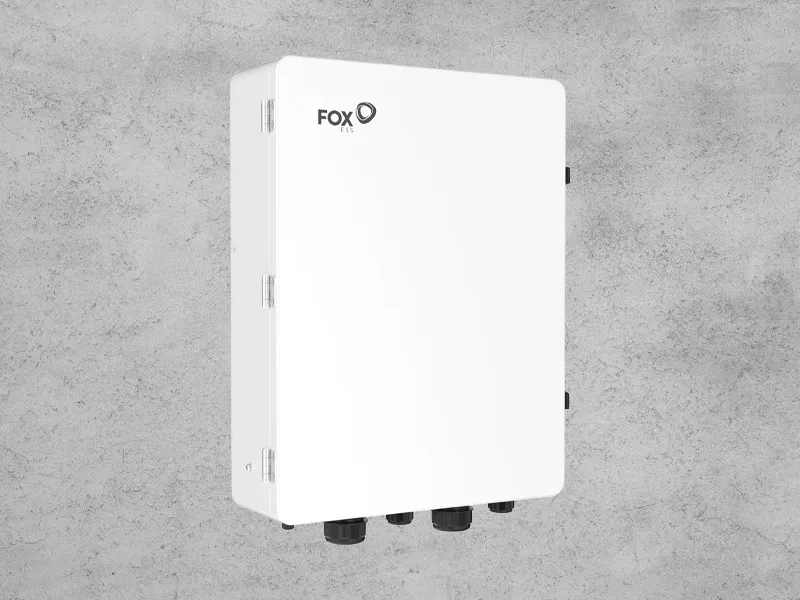
Most people end up somewhere in between: a backup gateway feeding a second, smaller consumer unit holding the circuits that matter — kitchen sockets, a lighting circuit, the boiler, the router. Everything else stays dead until the grid is back, which is what stops the battery emptying in two hours.
It is far cheaper to build this in on the day of installation than to add it later. Retrofitting usually means a second consumer unit, rewiring circuits across it, and in some cases an inverter that was never designed for backup in the first place.
What a 10 kWh battery will and won’t run
Two numbers decide this. Capacity (kWh) is how much energy is stored. Backup output (kW) is how much the inverter can deliver at any one moment, typically 3–5 kW — so a 3 kW kettle and a 2 kW oven together will trip it even with a full battery.
A household running sensibly uses roughly 2.5 to 3 kWh a day:
| Load | Typical draw | Over 24 hours |
|---|---|---|
| Fridge-freezer | 100 W when running | 1.0–1.5 kWh |
| LED lighting | 40–60 W | 0.3 kWh |
| Router, phones, laptop | 50–100 W | 0.5 kWh |
| Gas boiler pump and controls | 80–120 W intermittent | 0.5 kWh |
| TV or radio | 60–100 W | 0.3 kWh |
That puts a 10 kWh battery at roughly three days of essentials on its own — and much longer if there is daylight, because the solar keeps topping it back up. In December the panels will still add some charge on most days, though on a heavily overcast one it may cover only a small part of that list. Our solar and battery calculator will give you a rough figure for your own roof.
What it will not do:
- Electric shower — 8.5–10.5 kW. Beyond any domestic backup system.
- Electric oven and hob — 2–3 kW each, and hours of use. A single induction ring briefly, perhaps.
- Immersion heater — 3 kW continuously. It will flatten a full battery in three hours.
- Heat pump — 1–3 kW running, often 10–15 kWh a day in cold weather. Possible with a much larger battery, not with 10 kWh.
- EV charging — 7 kW. The car is the one thing that may help you rather than the other way round: some vehicles can export back to the house, but only with the right bidirectional charger. We cover that in our guide to vehicle-to-home charging in the UK.
Backup keeps your food cold, your lights on, your phones charged and your heating running. It does not let you carry on as though nothing happened.
What to do about it
If you already have solar or a battery, find out where you stand before you need to. Check your inverter model against the manufacturer’s datasheet for an EPS or backup output, look in your consumer unit for a separate backup board, and check your handover pack — MCS-certified installations come with documentation that should say. If you cannot tell, ask whoever installed it. It is a one-line answer.
If you are buying, the questions worth asking any installer are short:
- Does this system work in a power cut, and is that EPS or a full backup gateway?
- Which circuits stay live, and which go dead?
- What is the maximum backup output in kW, and what does that rule out?
- Will the solar recharge the battery during an outage, or only the grid?
- What does adding backup cost now, against adding it in three years?
If an installer is vague on any of these, that tells you something useful.
If you want the resilience without a full install, be realistic. A portable power station of 1–2 kWh will run a router, lights and phone charging for a day or two, and cost a few hundred pounds. It will not run a fridge-freezer for three days. A proper home battery fitted without solar will, if it is installed with backup, and it still earns its keep the rest of the year by charging on a cheap overnight tariff. Petrol generators are a different conversation again, with carbon monoxide and fuel storage attached.
And whatever you decide about electricity, the tinned food and the wind-up radio are still good advice. prepare.campaign.gov.uk has the full list and takes ten minutes to read.
Common questions
Not on their own. A standard grid-connected solar installation shuts down the moment the grid fails, because G98 and G99 require anti-islanding protection to keep engineers safe. You need either an EPS output or a backup gateway for the panels to be any use during an outage.
Only if it was installed with backup. A battery and hybrid inverter without an EPS output or a gateway will sit idle, however much charge is in it. Check your inverter datasheet or ask your installer.
Sometimes. It depends on whether your inverter supports it. Where it does, the work usually means fitting a gateway and a second consumer unit for the backed-up circuits. Where it does not, you are looking at an inverter change.
Run only essentials — fridge-freezer, lights, router, boiler controls — and a 10 kWh battery covers roughly three days. With daylight recharging it, longer. Use an oven, shower or immersion heater and you will have hours, not days.
For most homes, yes. It needs no fuel, makes no noise, produces no carbon monoxide, switches over automatically and earns money the other 364 days of the year. A generator wins only on sustained high loads.
Yes, with the Backup Gateway, and it is one of the better whole-home options — see what a Powerwall 3 costs. Several Fox ESS and Sigenergy systems do the same for less. If you already own a GivEnergy system, our guide to what the GivEnergy administration means explains where that leaves you.
Talk to us
We are an MCS, NAPIT and RECC certified installer based in Bletchley, Milton Keynes, covering Buckinghamshire, Bedfordshire, Hertfordshire, Oxfordshire and Northamptonshire. We handle solar panel installation and battery storage, with or without backup, and we will tell you plainly which one your house actually needs.
If you already have a system and simply want to know whether it would keep the lights on, ask us. We are happy to answer that without selling you anything.