Solar Installers — Milton Keynes
Solar Panels &
EV Chargers in Milton Keynes
Local, MCS & NAPIT certified installers based in MK3. Save up to £1,200/year. Free survey and fixed price — no surprises.
Is Milton Keynes Good for Solar Panels?
Short answer: yes. Here's the data.
Milton Keynes solar yield data
Milton Keynes sits in the South East Midlands and receives approximately 1,350–1,400 hours of peak sunshine per year — higher than the UK average of 1,250 hours. This means solar panels in MK perform well above average.
A 4kWp south-facing system in MK generates around 3,600 kWh per year. At today's grid rate (28p/kWh), that's worth up to £1,008 in avoided electricity costs before accounting for export income.
With a battery storage system capturing surplus solar for evening use, that figure rises to £1,400–£1,600/year — and the system pays for itself in 7–10 years.
- MK solar yield: ~900 kWh/kWp/year (south-facing)
- Grid electricity rate: 28p/kWh (April 2026)
- Smart Export Guarantee income: 7–15p/kWh on exports
- 0% VAT on all residential installations until March 2027
Fixed quote before work begins. Savings based on 28p/kWh grid rate.
Every Grid Square We Cover in Milton Keynes
Milton Keynes is not one housing stock, it is five. The grid square you live in tells us roughly when your roof was built, what it is covered in, and how the panels will need to be fixed to it. Here is how the city breaks down.
The original towns and villages — pre-1967
Stony Stratford, Wolverton, Old Wolverton, New Bradwell, Central Bletchley, Old Bletchley, Far Bletchley, Fenny Stratford, Water Eaton, Simpson, Woughton on the Green, Great Linford village, Willen, Newport Pagnell, Woburn Sands.
These pre-date the new city entirely. Expect Victorian and Georgian stock, natural slate or handmade clay tile, and rafters that were never sized with 20kg per square metre of solar in mind. Slate needs different fixings from concrete tile and is far less forgiving of anyone walking on it. Several of these are conservation areas, so a front-facing array may need consent even where permitted development would otherwise cover it.
First-wave new city — roughly 1970 to 1980
Netherfield, Beanhill, Coffee Hall, Eaglestone, Tinkers Bridge, Bleak Hall, Leadenhall, Fishermead, Oldbrook, Conniburrow, Bradville, Galley Hill, Fullers Slade, Stacey Bushes, Hodge Lea, Springfield.
This is the Radburn era — cars and pedestrians separated, houses turned away from the road. Two things matter for solar. First, roof pitches here are often shallow, and some of the best-known estates were built flat or to a single continuous roof plane, Netherfield most famously. A flat roof is not a problem, but it needs a ballasted or tilted frame rather than standard hooks, and that changes the price. Second, because the layouts turn houses away from the road, the orientation of your roof frequently has nothing to do with which way your front door faces. We check it on the survey rather than guessing from the street.
Second wave — roughly 1980 to 1995
Two Mile Ash, Heelands, Bradwell Common, Bradwell, Downs Barn, Downhead Park, Neath Hill, Pennylands, Greenleys, Giffard Park, Blakelands, Bolbeck Park, Stantonbury, Bancroft, Bancroft Park, Blue Bridge, Great Holm, Loughton, Loughton Lodge, Elfield Park, Crownhill, Wymbush.
The city settles into conventional pitched roofs with concrete interlocking tile. From a solar point of view this is the easy ground: predictable pitch, predictable fixings, usually a straightforward scaffold. Most installations on this stock are a one-day job. The thing worth checking is the consumer unit, because boards of this age are often at the point where an upgrade makes sense alongside the solar rather than later.
Third wave — roughly 1995 to 2010
Furzton, Emerson Valley, Shenley Brook End, Shenley Lodge, Shenley Church End, Shenley Wood, Westcroft, Tattenhoe, Kingsmead, Snelshall, Caldecotte, Walnut Tree, Walton, Walton Park, Walton Hall, Browns Wood, Old Farm Park, Tilbrook, Tower Gate, Monkston, Kents Hill, Kingston, Brinklow, Medbourne, Oxley, Hazeley, Grange Farm, Woodhill, Ashland, West Ashland.
Steeper pitches, denser layouts, and a lot of semi-detached and terraced roofs where the usable area is smaller than people expect. On a narrow terrace roof the array size is usually limited by the roof, not by your budget or your electricity use — which is why we quote from measurements rather than from bedroom count. Good, clean installs on the whole.
Modern and still building — 2010 onwards
Broughton, Brooklands, Fairfields, Whitehouse, Glebe Farm, Eagle Farm North, Eagle Farm South, Wavendon, Wavendon Gate, Tattenhoe Park, Oakridge Park, Newton Leys, Oakgrove, Middleton, Fox Milne, Northfield, Atterbury, Pineham, Campbell Park, Newlands, Willen Park, Tongwell.
The newest grid squares are the ones where the answer is least obvious. Some already have a token array fitted by the developer, often undersized and rarely with a battery. Others were built with air source heat pumps and no generation at all, which is an expensive combination on a standard tariff. Both are worth revisiting rather than assuming the builder sorted it. From March 2027 the Future Homes Standard requires solar on virtually all new homes in England, so the estates going up now are the last that will not have it as standard.
Milton Keynes has 27 conservation areas. The ones we are asked about most are Stony Stratford (designated 1975), Olney and Newport Pagnell (both 1969) and Woburn Sands (2003). Being in one does not stop you fitting solar — it means a roof slope fronting a highway may need consent that the same panel on the rear would not. We check the designation before quoting, not after.
Not listed here? We cover the whole MK postcode area and the surrounding towns, and we travel beyond it for the right job. Ask anyway — it costs nothing to check.
Why Choose a Local MK Solar Installer?
We Live Here
Our office is in Bletchley, MK3. When you call us, you're speaking to someone local. Our engineers drive from MK — no travelling expenses passed on to you.
Faster Response
Surveys booked within a week. Installations typically within 2–3 weeks of survey. If you have a post-installation question, we're 15 minutes away.
MCS & NAPIT Certified
Required to access the Smart Export Guarantee — the payment you receive for electricity you generate and export. Always check your installer is MCS & NAPIT certified.
5★ Local Reputation
18 five-star reviews, many from customers right here in Milton Keynes. Word of mouth is our biggest source of work — we can't afford to cut corners.
Solar Panels in Milton Keynes — FAQ
A typical solar panel installation in Milton Keynes costs £6,500–£8,500 for a 4kWp system (10–12 panels, suitable for a 3–4 bed home). Smaller 3.5kWp systems start from £6,500; larger 6.5kWp systems for bigger homes run to £9,500–£11,000. All residential installations qualify for 0% VAT until at least March 2027.
Yes. Milton Keynes receives approximately 1,350–1,400 peak sunshine hours per year — above the UK average. A south-facing 4kWp system in MK generates around 3,600 kWh per year. The relatively modern housing stock (many MK homes built from the 1970s onwards) also tends to have good roof orientation for solar.
Because we're based in Milton Keynes, we can usually book a free survey within a week and install within 2–3 weeks of the survey. For EV charger installations, turnaround is often quicker — sometimes within a week of the survey.
Dedicated Town Pages
Looking for solar installation in a specific MK town? See our dedicated pages for more local detail.
Jobs we have actually done here
A few of the systems behind the eras above, published with the customers' permission. More on the recent installs page.
Wolverton — 4kWp on slate
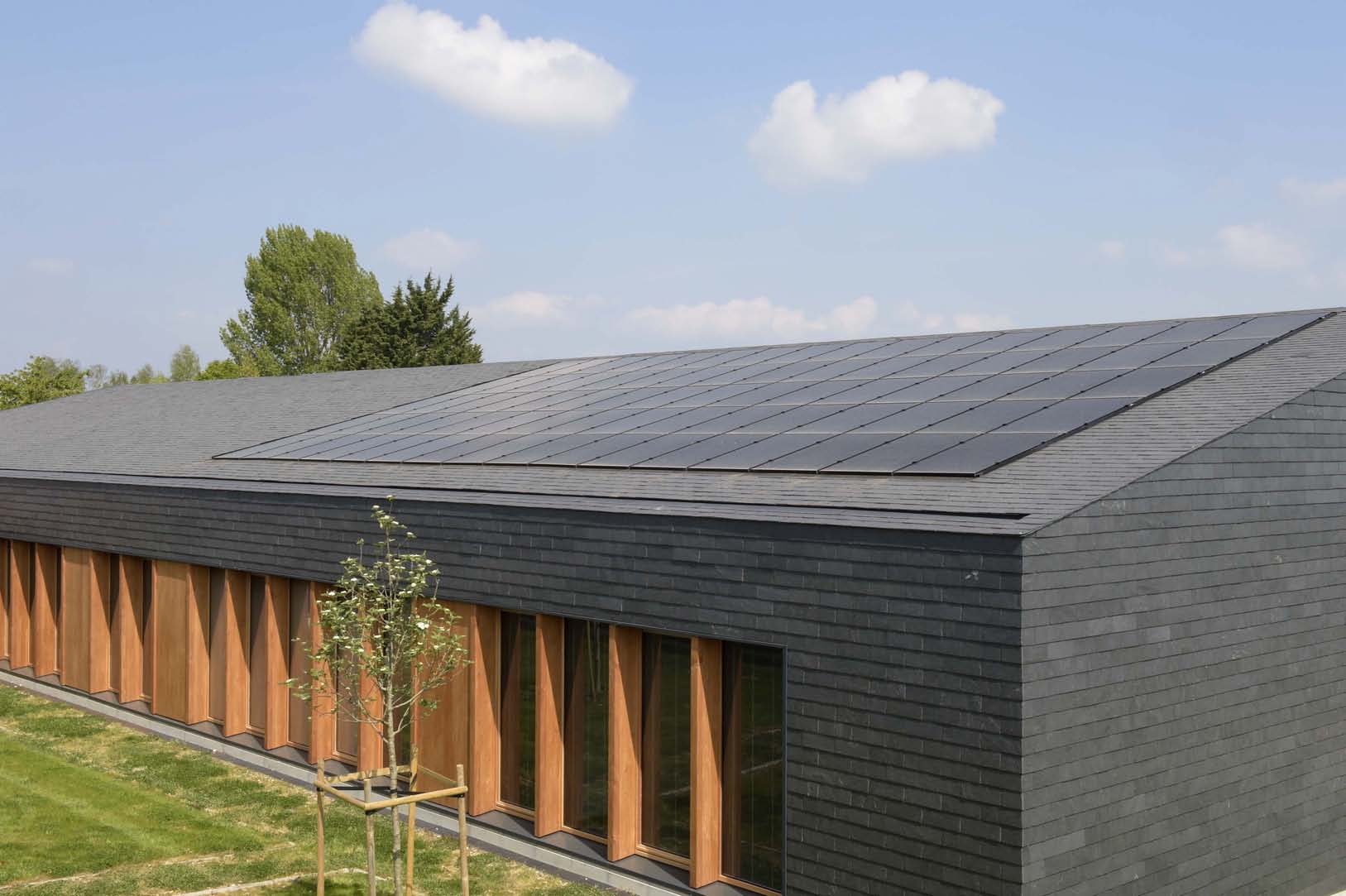
K2 single-rail mounting on a slate roof, in the Victorian railway-town stock. Around £1,100 a year. Slate is exactly the case where fixings and scaffold matter more than panel choice.
Newport Pagnell — 6kWp in-roof
GSE in-roof mounting, replacing the existing slates rather than sitting on top of them. About £1,400 a year. In-roof suits period property where a bolt-on array would look wrong.
Stony Stratford — 5kWp + 9kWh
South-facing in-roof install with a Fox ESS battery, in the conservation area. Around £1,650 a year — the battery is most of the difference against the Wolverton system.
Westcroft — 5kWp on tiles
K2 solid-rail on concrete interlocking tiles, third-wave MK stock. About £1,300 a year. This is the straightforward end: predictable pitch, predictable fixings, one day.
Bletchley — Zappi 7kW
Solar-aware smart charger, hardwired. Roughly £900 a year against public charging. Our own grid square, so this one was a five-minute drive.
What these have in common
Different eras, different roofs, different fixings. The array size and the price came from the roof in every case — which is why we measure rather than quote from the number of bedrooms.
Get a Free Survey in Milton Keynes
We'll assess your roof, size the right system, and give you a fixed price in writing. No obligation, no pressure.
Based in MK3 • MCS & NAPIT certified • 0% VAT • Fixed pricing